
07.2026 Group Briefing
U-Ming Marine Transport holds its 2026 shareholders' meeting
U-Ming Marine Transport / Huang Yizhen

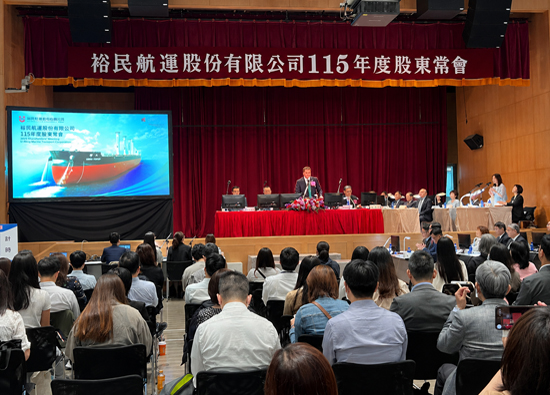
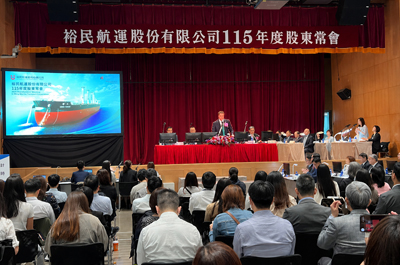 U-Ming Marine Transport held its regular shareholders' meeting on May 21st, during which various proposals were passed, including the financial statements and profit distribution for the year 2025. In 2025, the consolidated revenue reached NTD 15.566 billion, the net operating profit was NTD 3.704 billion, the after tax net profit was NTD 3.64 billion, the after tax earnings per share (EPS) were NTD 4.31, and the cash dividend per share was NTD 2.8. As of the first quarter of 2026, the cumulative undistributed surplus and statutory surplus reserve amounted to NTD 21.551 billion, demonstrating a stable financial structure and sufficient profit foundation. In addition, the operating performance in the first quarter of this year was impressive, with a net profit of NTD 988 million after tax, a significant increase of more than three times compared to the same period in 2025.
Outlook for the bulk shipping market in 2026: Structural transformation driving recovery momentum continues to heat up
The bulk shipping market will demonstrate resilience in 2026. According to Clarksons, a global shipping research firm, although the supply growth of vessel names is still slightly higher than the demand growth, under the trend of long voyages and geopolitical factors, the effective capacity of the market will be substantially tightened, driving the continuous improvement of industrial fundamentals. At the beginning of this year, freight rates have broken the tradition of seasonal weakness in the past, with Capesize vessels showing a leading performance in freight rates, indicating a clear improvement in market structure and confidence. U-Ming Marine Transport pointed out that the development of the Simandou iron mine in West Africa and the growth of Guinea's bauxite exports continue to drive the demand for long-distance shipping, significantly boosting the growth of the tonnage sea area and becoming an important driving force supporting the large bulk carrier market. In addition, global supply chain restructuring, increased demand for energy substitution, and post-war reconstruction also support transportation demand.
Although the overall supply of ships is still relatively loose on the surface, effective capacity will continue to be limited. It is expected that more than 3000 ships will enter the third peak of special inspections in 2026, and long-term dock maintenance will suppress short-term market supply. Meanwhile, under the influence of stricter environmental regulations, an increasing proportion of old ships, and historically low new ship orders, the expansion speed of market capacity is limited, which helps to support the overall freight rate level. U-Ming Marine Transport stated that benefiting from the rebound in demand for iron ore and grain transportation, coupled with limited growth in ship supply, the BDI (Baltic Dry Index) index has shown a trend of recovery in 2026. Under the continuous optimization of market fundamentals, the bulk shipping market is gradually emerging from the economic downturn and entering a stage of structural recovery.
Diversified layout of green shipping towards the goal of tens of millions of load capacity and net zero
In the face of global supply chain restructuring and energy transformation trends, U-Ming Marine Transport will continue to expand its core fleet size, while accelerating its low-carbon and new energy layout to enhance long-term competitiveness. In the third quarter of 2026, U-Ming Marine Transport's first liquefied natural gas (LNG) carrier will officially join the operating fleet, marking an important milestone for the company to move towards diversified operations and further expand its energy transportation footprint. In addition, U-Ming Marine Transport continues to promote fleet expansion plans to enhance its global market competitiveness. In the second quarter, the board of directors has approved the construction of four additional 210000 ton Capesize and four 64000 ton Ultramax bulk carriers, moving towards the "dual growth" goal of a fleet size exceeding 100 ships and a total deadweight tonnage exceeding 10 million tons.
In terms of green shipping, U-Ming Marine Transport plans to introduce biodiesel as an alternative fuel, leading its own bulk shipping fleet in actual ship trials and operational verification, actively promoting the decarbonization transformation of dry bulk shipping. After future introduction, in addition to helping to reduce carbon emissions, it can also alleviate the impact of carbon fees and the EU Emissions Trading System (EU ETS), while improving the performance of Carbon Intensity Index (CII) and route competitiveness. On the other hand, the company continues to expand into the Asia Pacific offshore wind power market. U-Ming Marine Transport Wind Energy Company (UMO) and Purus Group in the UK jointly established UPO Wind Energy Holdings to strengthen the operation and maintenance of offshore wind power in the region. U-Ming Marine Transport will continue to deepen the application of green shipping technology, expand the clean energy market, and steadily move towards the goal of sustainable shipping.
Deepening sustainable governance to become a model for ESG sustainability in industries
In 2025, U-Ming Marine Transport was once again selected as a constant stock in the FTSE 4Good Taiwan Sustainability Index and was selected as one of the "Top 100 Foreign funded Enterprises in Taiwan", showcasing the company's performance in sustainable governance and corporate value. At the same time, it won the TCSA Taiwan Corporate Sustainability Award for "Top 100 Sustainable Model Enterprises", "White Gold Award for Sustainability Report", and "Workplace Welfare Award", and won the HR Asia "Best Corporate Employer Award" for five consecutive years, continuously deepening ESG governance, employee care, and friendly workplace culture. In addition, U-Ming Marine Transport has also won the Gold Award for ESG Sustainable Transportation and been selected as one of the Top 100 Carbon Competitiveness Companies in Business Weekly. It has also obtained multiple ISO international certifications to strengthen its low-carbon transformation and sustainable business layout.
Fleet information
U-Ming Marine Transport currently has bulk cargo ships such as Capesize, Panamax, Post Panamax, Ultramax, cement specific vessels, Very Large Crude Carriers (VLCCs), and Very Large Ore Carriers (VLOCs), as well as diversified vessel types such as Marine Wind Personnel Carriers (CTVs), Operations and Maintenance Service Vessels (CSOVs), and Liquefied Natural Gas Carriers. Our own fleet, including joint ventures and under construction vessels, has a total capacity of 84 ships and a total deadweight tonnage of nearly 10 million tons. U-Ming Marine Transport has subsidiaries overseas in Singapore, Hong Kong, Xiamen, etc., achieving a global business layout. In Taiwan, U-Ming Marine Transport has a subsidiary focused on green energy transportation, U-Ming Marine Transport Wind Energy.
#