

03.2025 Life Guide
Comprehensive upgrade of free health check-up policy by 2025
Far Eastern New Century Corporation / Zeng Jieru

 Do you know? Starting from January 1, 2025, anyone over the age of 30 can enjoy free health check ups! According to the latest data from the National Health Administration, the prevalence of hypertension, hyperglycemia, and hyperlipidemia among the 30-39 age group in the National Nutrition and Health Survey from 2019 to 2023 is worrying. Among them, hypertension accounts for 9.7%, hyperglycemia accounts for 2.5%, and hyperlipidemia reaches 18.7%. In addition, the number of new cancer cases in 2022 has exceeded 130000, and the cancer clock has turned fast by 17 seconds, which is equivalent to one person being diagnosed with cancer every 4 minutes and 2 seconds. These numbers not only warn of the importance of health management, but also prompt the Ministry of Health and Welfare to launch a new measure - the "Adult Preventive Health 880 Program". This issue of the "Health Column" will take you through the key points in one go.
Modern people are busy with work and easily neglect their health. In order to enable more young people to grasp their own health status early and develop the habit of regular health checkups, starting from 2025, the "Adult Preventive Health 880 Program" will lower the age threshold for free health checkups from 40 to 30 years old, while expanding the scope of public funded screening for the four major cancers and adding HPV virus public funded testing projects. The main content is as follows:
1、 Adult preventive healthcare
1. Applicable objects and frequency of health check ups
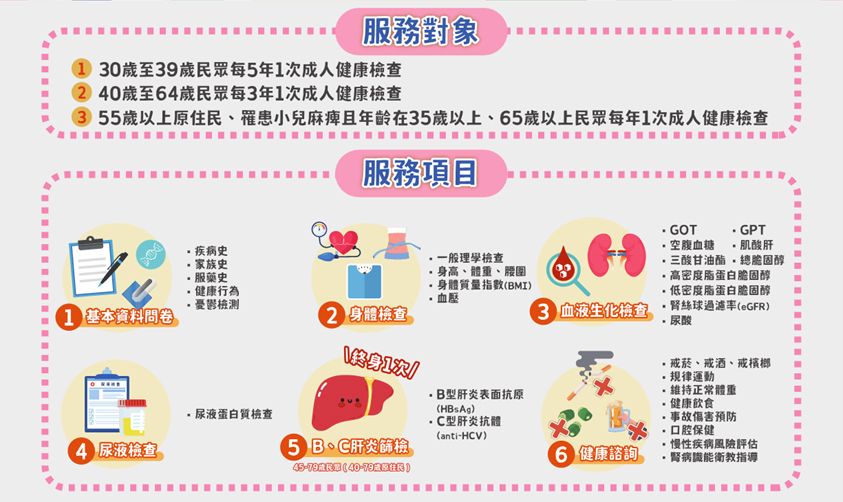
(1) 30 to 39 years old: Enjoy free health check ups every 5 years (new).
(2) 40 to 64 years old: Enjoy free health check ups every 3 years.
(3) Indigenous people aged 65 and above, indigenous people aged 55 and above, and polio patients aged 35 and above: enjoy one free health check-up per year.
2. Health examination content
(1) Questionnaire survey: disease history, family history, medication use, health behavior, depression detection, etc.
(2) Physical examination: General physical examination, height, weight, blood pressure, waist circumference, and body mass index (BMI), etc.
(3) Laboratory examination:
Urine test: protein content check.
Renal function testing: Evaluating kidney health through glomerular filtration rate (eGFR).
Blood test: covering liver function, blood glucose, blood lipids, uric acid and other items.
Hepatitis screening: People aged 45-79 (indigenous people aged 40-79) can enjoy one lifetime screening for hepatitis B and C.
(4) Health consultation: including advice on quitting smoking, reducing alcohol consumption, quitting betel nut, regular exercise, as well as chronic disease risk assessment and health education services.
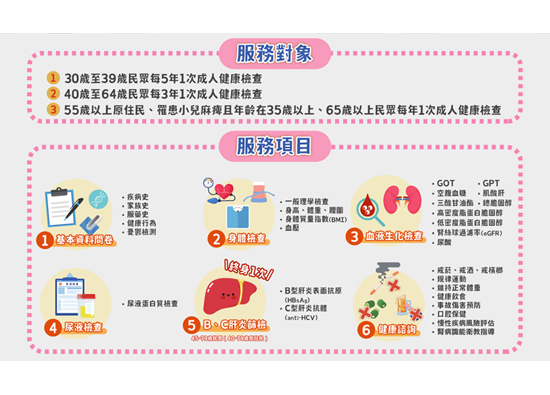
Figure 1. Service recipients and projects (Image source: Taipei City Government Health Bureau)
2、 Important cancer screening
Cancer is the result of abnormal cellular evolution and the number one killer threatening public health. Early detection and treatment are key to preventing cancer from worsening. To this end, the Ministry of Health and Welfare provides free screening services for high-risk groups based on international evidence. As long as they meet the qualifications, they can receive relevant examinations and take early control of their health.
1. Cervical cancer: Women over 30 years old should undergo cervical smear examination once a year (it is recommended to undergo cervical smear examination at least once every 3 years).
2. Breast cancer: Women aged 45-69, as well as women aged 40-44 who have had breast cancer in their second degree blood relatives, should undergo mammography every 2 years.
3. Colorectal cancer: Individuals aged 45-74 and those aged 40-44 with a family history should undergo fecal occult blood testing every 2 years.
4. Oral cancer: Individuals over 30 years old who chew betel nut (including those who have quit betel nut) or smoke, and indigenous individuals over 18 years old who chew betel nut (including those who have quit betel nut), are required to undergo oral mucosal examination every 2 years.
5. Lung cancer: Provide low-dose computed tomography (LDCT) every 2 years for the following high-risk groups--
Individuals with a family history of lung cancer: males aged 50-74 or females aged 45-74, whose parents, children, or siblings have been diagnosed with lung cancer.
Heavy smoking history: Individuals aged 50-74 who have smoked at least 30 packs per year, have the intention to quit smoking, or have been a heavy smoker for 15 years.
3、 How to participate in free health check ups?
The way to participate in free health check ups is quite simple and convenient. You can go to the local clinic or health center to inquire if they provide relevant services, or log in to the official website of the Ministry of Health and Welfare to check the list of designated medical institutions to confirm suitable health check ups locations. Before conducting the examination, attention should be paid to following relevant regulations, such as maintaining an empty stomach for at least 8 hours, and it is recommended to schedule the examination in the morning to ensure the accuracy of the results. In addition, although health check-up services are free, some institutions may charge registration fees. It is recommended to confirm the relevant details with the institution in advance and make adequate preparations.
The free health check-up policy will be fully upgraded by 2025, not only lowering the age threshold, but also expanding the screening content to assist the public in understanding their personal health status earlier. Arrange time now to participate in free health check ups, protect your and your family's health, and move towards a more peaceful life! (Reference: National Health Administration)
#