
03.2025 Life Guide
Is having blood in the stool a sign of colorectal cancer?
Dr. Guan Taiquan, Colorectal Surgery, Far Eastern Memorial Hospital /


 Mr. Chen, who is 55 years old, is a diligent office worker. Recently, he undertook a project and worked overtime until 8 pm for several days. His diet was also abnormal. One day while using the restroom, a large amount of blood was suddenly released. Thinking of my father's death from colorectal cancer more than 20 years ago, I quickly went to the colorectal surgery clinic for treatment. Upon entering the consultation room, I immediately asked the doctor, "Do I have colorectal cancer?" Many people share the same question as Mr. Chen, whether relieving bloody stools means having colorectal cancer? This issue of 'Health Column' will answer your questions.
 The cause of bloody stool is mostly not colorectal cancer
According to statistics, the majority of bloody stools are caused by anal diseases, including hemorrhoids, fistulas, anal fissures, etc., followed by colonic diverticulum, colonic inflammation, colonic polyps, upper gastrointestinal (stomach, duodenum) bleeding, etc. The proportion of bloody stools caused by colorectal cancer (referred to as colorectal cancer) is less than 10%.
The current situation of colorectal cancer in Taiwan
Colorectal cancer has been the cancer with the highest incidence and third highest mortality rate in Taiwan for 13 consecutive years, with an annual number of newly diagnosed cases ranging from 13000 to 16000, of which about 1/4 are stage four. Common risk factors include: over 50 years old, family history of colorectal cancer, diabetes, obesity, smoking, drinking, high-fat and low fiber diet, eating red meat (pig, cow), inflammatory enteritis, etc. In the case, Mr. Chen's father passed away due to colorectal cancer, no wonder he was so worried.
Common symptoms of colorectal cancer
Mr. Chen asked again, "If the majority of bloody stools are not caused by colorectal cancer, what are the symptoms of colorectal cancer
In fact, besides bloody stools, changes in bowel habits, incomplete bowel movements (urgency and heaviness), bloating, abdominal pain, weight loss, fatigue, anemia, etc. are all common symptoms. However, in recent years, it has been found that the most common symptom is "no symptoms".
Diagnosis of colorectal cancer
Mr. Chen continued to ask, "If there are no symptoms, how do you know if you have colorectal cancer
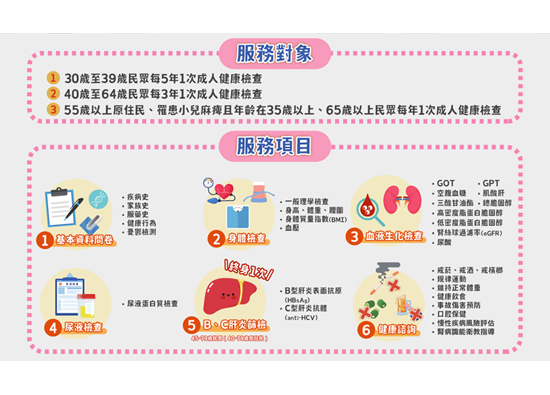
The Ministry of Health and Welfare Bureau of Health Promotion provides free fecal occult blood testing every 2 years for individuals aged 45-74 and 40-44 with a family history. If the test is positive, it is recommended to undergo colonoscopy in the future. However, a positive fecal occult blood test does not necessarily mean there is cancer, it may only be polyps, and most of them are caused by hemorrhoids; On the contrary, a negative result may not necessarily be a problem, because although this type of examination is cheap, its sensitivity is not high. If there are clinical symptoms, even if it is negative, it is still recommended to arrange a colonoscopy examination. It is worth noting that there is a trend towards younger age groups for colorectal cancer. In the United States, it is recommended that the screening age be lowered to 45 years old and that individuals undergo fecal occult blood tests annually.
colonoscopy
Mrs. Chen beside me asked, "Last time I had a colonoscopy to remove a polyp, how often do I need to track it
Colonoscopy is a procedure that uses an endoscope to examine the rectum all the way to the cecum, the deepest part of the large intestine. After magnification by the endoscope, small polyps are removed. If the first colonoscopy examination is normal, a fecal occult blood test can be performed every 2 years; If low-risk polyps are found, it is recommended to follow up with colonoscopy for 3-5 years; If the diagnosis is high-risk polyps, it is recommended to follow up with colonoscopy once every 2 years, but considering that everyone's cleanliness of the colon may vary, everything should be based on the doctor's advice.
Treatment of colorectal cancer
Mr. Chen took the initiative to request a colonoscopy and asked, "When my father was diagnosed, the doctor said he could only do chemotherapy, but next door Mr. Wang could have surgery. How should colorectal cancer be treated
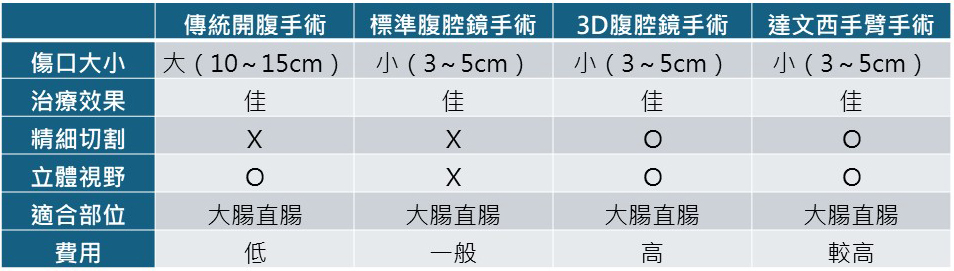
The main treatment for colorectal cancer in the first to third stages is surgery, while in the fourth stage, chemotherapy plus targeted therapy is used; However, second and third stage rectal cancer may also be treated with electrochemotherapy before surgery. The current surgical treatment is very advanced. In addition to traditional open surgery, there are also many minimally invasive surgeries to choose from, such as standard laparoscopy, 3D laparoscopy, and da Vinci robotic arm surgery (see Table 1). More than 70% of colorectal cancer can be removed using minimally invasive methods. Due to the different conditions of each patient and the appropriate surgical approach, it is necessary to have a thorough discussion between doctors and patients.
Table 1: Comparison of Minimally Invasive Surgeries
 On the other hand, the effectiveness of chemotherapy has also improved with medical advancements, with fewer side effects. Over the past decade, targeted drugs have brought better therapeutic effects to stage IV colorectal cancer. In addition, the concept of "precision medicine" is gradually becoming popular, and accurate assessment of tumor gene morphology and precise medication have become mainstream nowadays.
How to prevent colorectal cancer
At the end of the consultation, Mr. Chen asked, "How can we prevent colorectal cancer
The most basic principle for preventing colorectal cancer is to maintain a normal and healthy lifestyle, avoid smoking and drinking, eat five fruits and vegetables a day, avoid excessive red meat, and it is recommended to have the first colonoscopy at the age of 50. If there is a family history of colorectal cancer, it should be done as early as the age of 40. After all, most colorectal cancers are caused by polyps growing slowly. If they can be removed immediately and monitored regularly, it is the best way to prevent them.
Note: Dr. Guan Taiquan's expertise includes colorectal cancer surgery, functional colorectal diseases, colonoscopy examination, colonoscopy polypectomy surgery, general abdominal emergencies, anal diseases, and wound assessment and treatment
Introduction by Dr. Guan Taiquan
#