
08.2026 Office Talk
Dome Economics: Reshaping Cities and the Future of Business
Group Integrated Efficiency and Retail Planning Headquarters / Investment and Operation Analysis Team

 The Taipei Dome, which has been put into use in recent years, is not only a space for hosting events, but also an important carrier for driving foot traffic, consumption, and regional upgrading. It has further sparked a development boom for National Taiwan University style sports venues, shifting the thinking of urban development from a single public construction to a composite development model that combines sports, commerce, entertainment, and transportation. Starting from international cases and core development projects in Taiwan, this article explores the core logic of the "sports social ecosystem" and how large venues can become new engines driving urban development.
The Rise of Sports+Business+Entertainment Sports Social Ecosystem
Under the 'Stadium Approved Development' (SAD) model, venues have gradually transformed from public facilities that rely on government budgets to urban traffic entrances with high customer acquisition capabilities. Through the integration of sports events, retail commerce, catering and entertainment, sightseeing and accommodation, and public transportation, a composite ecosystem that can continuously create people flow and consumption is formed.
Behind this transformation is a change in the consumption behavior of the new generation. As consumers increasingly value experience, socialization, and immersive participation, venues have evolved from single function spaces to urban nodes that integrate sports, leisure, entertainment, and lifestyle services, thereby enhancing the value of surrounding areas.
The Life Circle Management of Tokyo Dome, an International Benchmark
The Tokyo Dome is the most representative venue complex development project in Asia, and its key to success lies in positioning the venue as the core of the living circle and thoroughly practicing the ultimate business philosophy of "using it for 400 days in one year". By leveraging the transportation advantages of three stations and six railway networks, connecting hotels, amusement parks, spa facilities, and commercial spaces, we aim to create a 24/7 and diverse consumer scene. Every year, it attracts over 40 million visitors, the vast majority for daily entertainment and leisure, not just limited to sports events. If the venue can integrate into the daily life of the city, it can withstand the operational risks caused by fluctuations in the event schedule and maintain the long-term stability of the business model.
In the first year of the Taiwan Dome, the Taipei Dome drove the expansion of the Double North territory
In November 2023, the Taipei Dome, covering an area of 10.2 hectares, was officially put into use, filling the last piece of the puzzle for Taiwan's international indoor events and marking a watershed for Taiwan's transition from project development with a "social welfare mindset" to a "multifunctional commercial engine". The popularity of sports events and entertainment directly translates into foot traffic and business opportunities in shopping malls; The 36000 ping shopping mall affiliated with it is operated by the SOGO team. If it is further connected to the Xinyi Plan area and the East District commercial district, it is expected to form a new consumption axis and flip the commercial and consumption map of Taipei's East District.
The successful example of Taipei Dome has also prompted county and city governments to accelerate the development of large-scale venues. New Taipei City adopts a dual track approach of developing large and small stadiums, each responsible for the dual tasks of developing emerging peripheral areas and updating the core urban area. The "New Taipei Dome" on the periphery is currently evaluated for two locations: one is the Shulin Jiwu Base, covering an area of 10 hectares, adjacent to the Beijie Huilong Station and the Taiwan Railway Shulin Station, which can connect to the future Taoyuan MRT Brown Line; The second is the Tamsui Phase II, which has a development flexibility of 600 hectares and the transportation benefits of the opening of the Tamkang Bridge.
The "New Taipei Arena" located in the core area of Banqiao is planned to renovate the second sports field to revitalize the existing commercial district. However, the case has failed to attract investment three times recently, and in the future, private enterprises may increase their investment willingness by adjusting investment conditions or promoting participation models.
The urban upgrading strategy of Taichung City, a new battlefield in central Taiwan, and the twin giant stadium
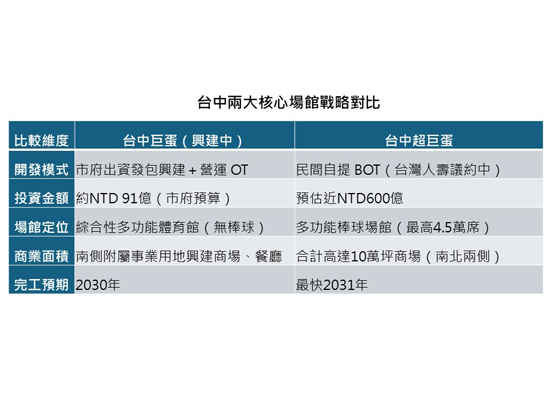
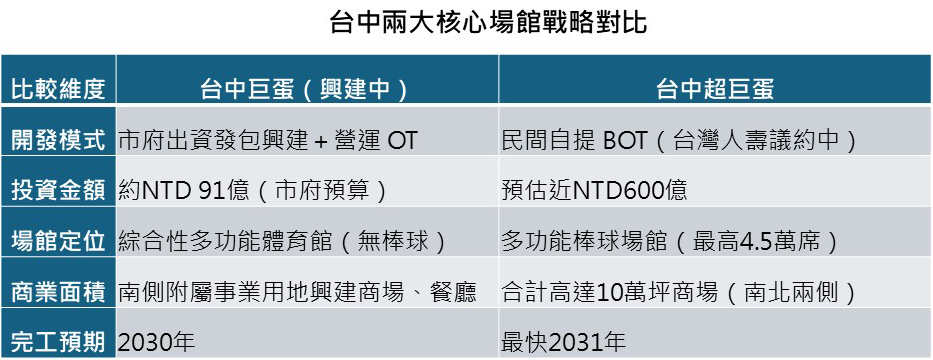
Taichung City presents a development trend of "one city, two eggs". The "Taichung City Dome" led by the city government and the "Super Dome Case" self initiated by the private sector have respectively driven the development of the 14th phase redevelopment zone and the Shuinan Economic and Trade Park. Among them, the "super giant egg" adopting the BOT model is regarded as a benchmark case for the insurance industry to expand into large-scale composite development and transform from financial capital to urban development.
Blueprint implementation from 'building houses' to' creating a living circle '
Looking at Taiwan as a whole, the planning and investment promotion of large venues have entered a white hot stage, including projects such as New Taipei Arena/Arena, Taoyuan Zhongli Sports Park, Aviation City Phase II, Taichung City Dome/Super Dome, Tainan Arena, and Kaohsiung Chengqing Lake Sports Zone, all of which have emerged one after another.
However, successful venue development does not rely solely on hardware architecture, the real key lies in the balance of three dimensions:
The convenience of transportation network: Whether it is the joint construction of Taipei University Dome and Banqiao Line, or the MRT planning of Zhongli Sports Park, the high accessibility of public transportation is a prerequisite for gathering traffic.
The long-term value of life insurance funds: Insurance funds have become the dominant force in sports parks, pursuing stable liquidity and asset appreciation brought by "70 year above ground rights" rather than short-term speculative returns.
The balance between commercial benefits and public interests: Shopping malls and venues have high complementarity, which can not only increase foot traffic, but also increase the return rate and investment incentives for developers. If the public welfare terms are too strict and the royalties are too high, it will actually suppress the willingness of private investment.
The future stadium should not just be a concrete sports field, but a "sports social ecosystem" deeply integrated with local commercial chains, mass transportation, and consumer experience. Only by implementing this transformation can sports venues be integrated with urban planning and become the core engine driving urban development.
A new retail track for destination oriented large-scale composite development
From the perspective of retail industry development, Taiwan is moving from traditional "business district orientation" to "destination orientation". Competitive commercial development not only provides shopping space, but also integrates large venues, entertainment facilities, cultural content, and transportation nodes, creating reasons for consumers to visit specifically. In other words, large-scale composite development that integrates experience, socialization, entertainment, and content economy will become an important carrier for the next wave of urban and commercial development.
For Far Eastern Group, which spans multiple industries, the key to the future lies in how to perfectly integrate and operate across retail, entertainment, transportation, restaurants, and membership economy. This is not only a market trend, but also a necessary path for large retail developers to transform from "space providers" to "life service integrators".
#