
04.2026 Office Talk
Reshaping Retail Competitiveness with Data as the Foundation
Group Integrated Efficiency and Retail Planning Headquarters / Data Technology Group

 In the era of rapid digitization and AI evolution, the retail industry is moving from "experience oriented" to "data-driven". Consumer behavior no longer occurs solely through a single channel, but is triggered at multiple points across physical, online, and real-life scenarios. If enterprises still rely on past intuition and fragmented data, it will be difficult to grasp the market rhythm in real time, and even more difficult to support long-term decisions. This article focuses on the FERG smart platform for planning headquarters' collaborative retail enterprise development, demonstrating the group's efforts to build a data-driven decision-making foundation. Through data governance and analysis capabilities, the platform aims to transform retail operations from experience driven to a predictable and verifiable intelligent decision-making model.
Data - a key asset for retail operations
In the B2C industry, customer behavior is highly dispersed and rapidly changing, and consumer decisions are often influenced by multiple factors such as price, experience, channel convenience, and brand sentiment. The customer's journey is no longer limited to a single field, but shuttles between physical stores, e-commerce platforms, membership apps, community interactions, and various life scenarios, forming a multi-point triggered online and offline footprint.
This makes retail operations no longer just about managing goods and space, but rather integrating observation and precise response to the "omnichannel customer behavior trajectory". Every transaction, visit, click, and interaction is a behavior signal that can be accumulated and analyzed. Through data platform integration and the introduction of analytical capabilities and tagging, enterprises can see changes in customer structure and consumption habits, predict the growth potential and movement trajectory of different groups, optimize product combinations, channel strategies, and spatial allocation, and thereby improve the accuracy and return on investment in marketing.
In other words, data is not just a "record" of operations, but a key asset for integrating online and offline customer footprints, understanding market changes and predicting trends, and is also the core foundation of data-driven retail intelligent decision-making.
Cross store and cross channel integration decision-making challenges
The integration analysis of cross store points and channels is the core for finance and operations to master multi-channel behavior and accurately allocate resources. However, in practice, data is often scattered across different POS and digital platforms, with inconsistent definitions and high reliance on manual processing, resulting in inconsistent analytical approaches and seriously affecting the timeliness and accuracy of decision-making.
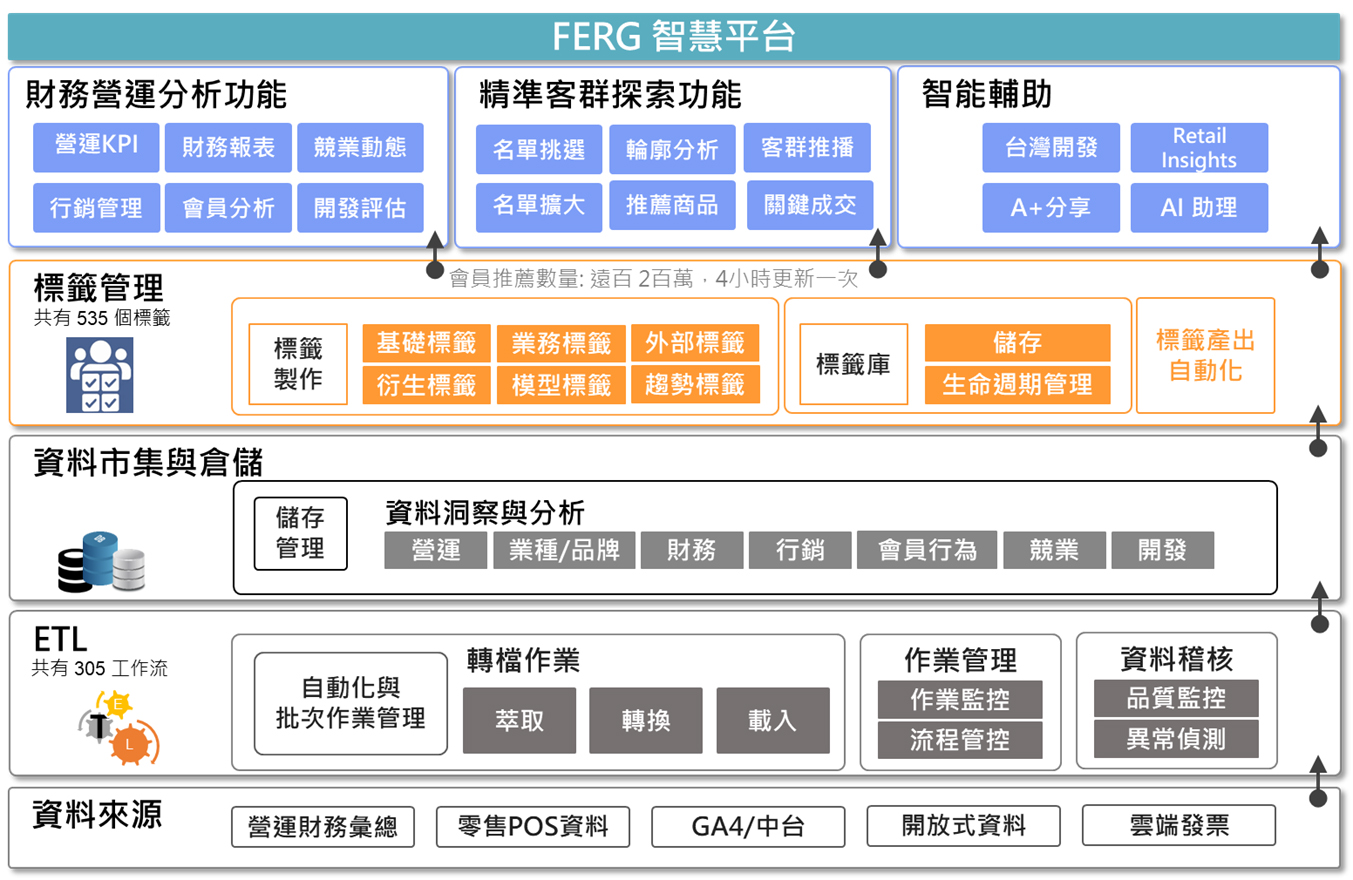
Therefore, the FERG smart platform plays a key role in standardizing and integrating cross channel transactions, financial operations, and external data through automated processes, coupled with audit mechanisms, to establish a sustainable and cumulative data governance architecture. This not only significantly reduces the duplication cost of data reorganization, but also enables enterprises to transform data into stable business insights based on consistent analysis.
The FERG smart platform transforms multiple indicators such as operations, finance, marketing, and member behavior into a shared data marketplace, unifying the overall analysis language. This not only effectively solves pain points with different cross unit perspectives, but also shifts the team from "digital disputes" to "structural insights".
Figure 1 FERG Smart Platform Data Service Process
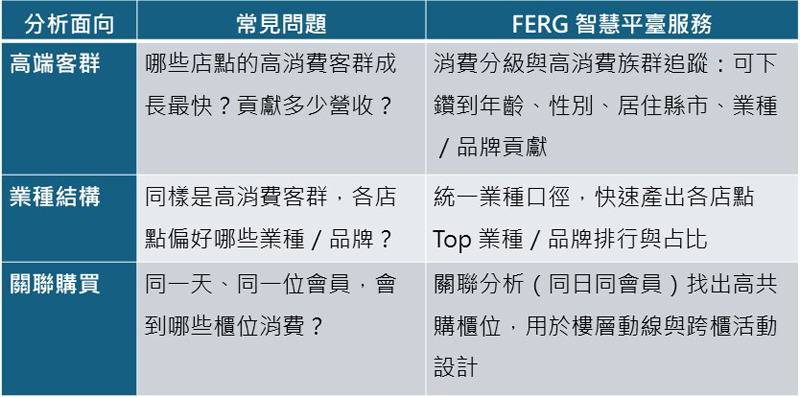 Table 1: Insights into Driving Cross Store and Cross Container Operations Cases
 Marketing decisions shift from intuition to data validation
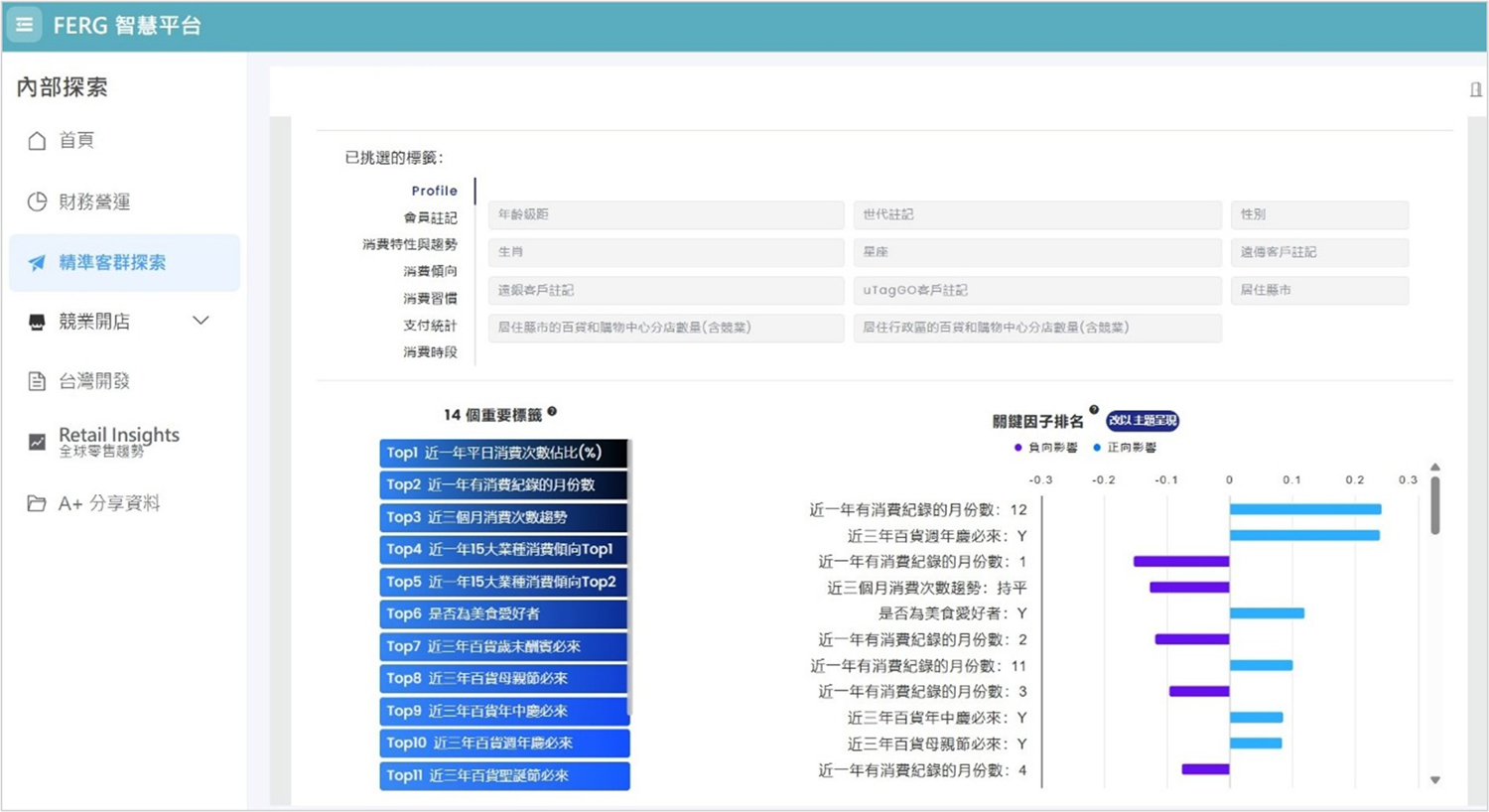
In the environment of expanding customer base and dispersed marketing channels, the core of marketing has shifted from simple resource investment to making scientific allocation decisions within limited resources. FERG Smart Ping's "precise customer group exploration" in Taichung City is the key to improving decision-making quality, overcoming the limitations of relying solely on intuition to deal with complex customer structures in the past.
FERG Smart Platform abandons preset tags and instead starts from actual behaviors such as consumption frequency, amount, time, and cross channel footprint, restoring the objective relationship between customers and brands. Through structured comparative analysis, marketers are better able to accurately identify differences and behavioral influencing factors among different ethnic groups.
Under this architecture, the role of data analysis is not to replace human judgment, but to reduce decision-making uncertainty. When decisions can focus on directional consistency and resource efficiency, data-driven approaches can truly become the core of corporate governance processes.
Figure 2: Exploration of Precise Customer Groups on FERG Smart Platform
 In recent years, consumption data from mass market channels has shown that overall consumption behavior is gradually shifting from centralized and large-scale procurement in the past to a more rational and daily demand driven consumption model. Under this trend, consumption is no longer just about "how much to buy at once", but more frequently occurs within the nearby living circle. Therefore, the population structure and actual living appearance around the store have become important foundations that affect operational performance.
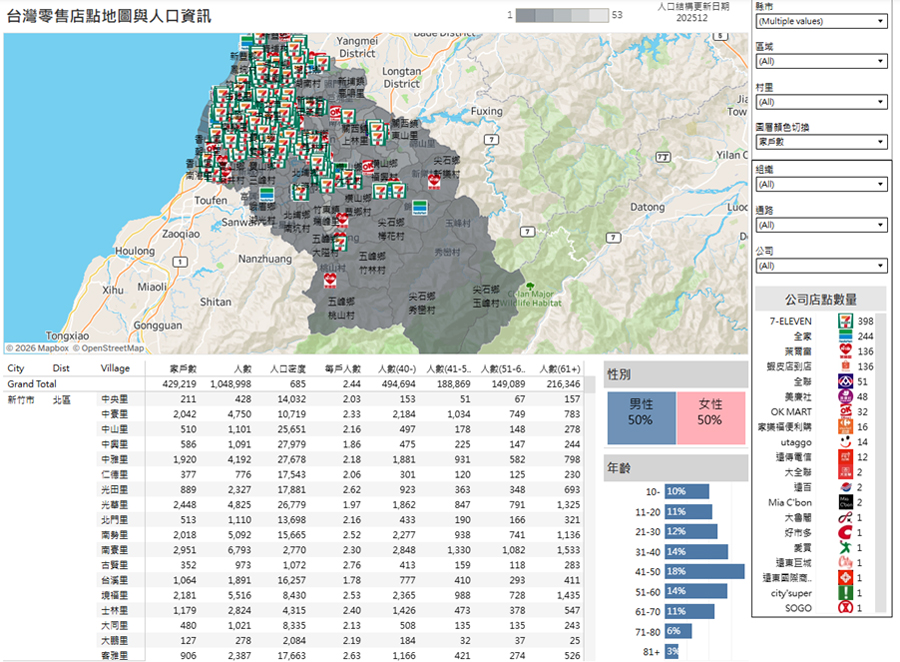
The FERG smart platform integrates population data through retail store maps, transforming scattered information into decision-making tools with a spatial perspective. It presents the administrative and neighborhood boundaries around the store in a map format, and matches it with the number of households and population, age and gender structure, as well as the penetration of consumer members. It assists the operation team in quickly identifying potential areas with a high population base but low membership penetration, and confirms core business districts with stable customer base, transforming population data from static statistics into actionable operational insights.
Figure 3 FERG Smart Platform - Taiwan Retail Store Location Map and Population Information
Data driven sustainable competitiveness
In the era driven by AI and data technology, the essence of enterprise competition has shifted from 'who has higher performance' to 'who can see structural changes earlier'. The value of data lies not in looking back at the past, but in predicting the future. When enterprises can establish a consistent data language and transform dispersed signals into actionable insights through AI, decisions will no longer rely on intuition, but will be based on verifiable facts.
The significance of the FERG intelligent platform is not only an analytical tool, but also the core infrastructure for the group to move towards data governance and AI decision-making. When data is upgraded from a 'rearview mirror' to a 'navigation system', enterprises can continuously make more accurate and forward-looking business choices in uncertain market environments, accumulate long-term competitive advantages, and achieve sustainable growth.
#