
04.2026 Office Talk
Guidelines for Enterprises and Individuals to Respond to the Implementation of the Basic Law on Artificial Intelligence
Far Eastern New Century Corporation /

.jpg) On January 14, 2026, Taiwan officially announced and implemented the "Artificial Intelligence Basic Law", which consists of 20 articles. This is the first AI specific law, providing clear guidance and framework for the industry during the regulatory transition period, and also marking Taiwan's official shift from a technology follower to a governance leader. This article provides readers with a comprehensive analysis of the regulations themselves, as well as professional legal interpretations such as Li Law, Economic Daily News, and CIO Taiwan, to examine the substantive impact of the new law on the business environment and individual rights.
On January 14, 2026, Taiwan officially announced and implemented the "Artificial Intelligence Basic Law", which consists of 20 articles. This is the first AI specific law, providing clear guidance and framework for the industry during the regulatory transition period, and also marking Taiwan's official shift from a technology follower to a governance leader. This article provides readers with a comprehensive analysis of the regulations themselves, as well as professional legal interpretations such as Li Law, Economic Daily News, and CIO Taiwan, to examine the substantive impact of the new law on the business environment and individual rights.1、 Governance Architecture: Guided by Seven Principles
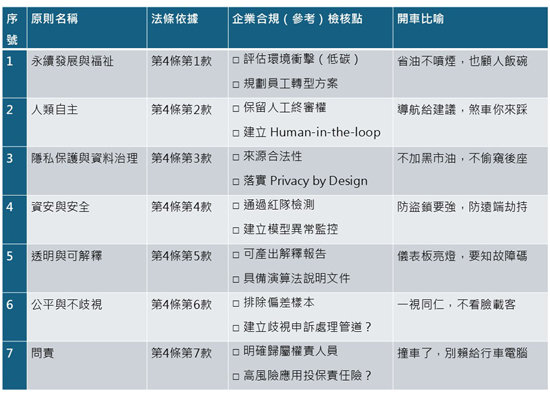
According to Article 4 of the Basic Law on Artificial Intelligence, all AI systems developed in Taiwan must follow seven principles. Relevant experts such as Law Firm, Economic Daily News, and CIO Taiwan have summarized their important inspection points as follows. For ease of understanding, the author uses the driving scenario as an analogy.
2、 Risk classification framework: Traffic light supervision system
The core of enterprise compliance lies in the "risk classification mechanism" established in Article 16 of this Law, which refers to standards such as the EU AI Act, promotes the risk classification framework, and assists various regulatory authorities in formulating management standards.
Low risk category (green light zone): For example, general customer service chatbots, which have relatively relaxed regulatory requirements to encourage innovation and can be deployed quickly.
High risk category (red light district): Although the law does not list a specific list, according to expert interpretation, for those involving significant impacts on people's rights and interests such as financial lending, medical diagnosis, and personnel recruitment, a complete verification mechanism must be established, and responsibility attribution and insurance mechanisms must be clearly defined.
3、 Enterprise Response Strategy: Combining Compliance with Competitiveness
Faced with the new law, companies should view it as a 'trust asset' for entering the global supply chain. Lawyer Chen Jianzhi also pointed out that compliance mechanisms can become a "moat" for enterprises to establish competitive advantages. For example, Article 10 of this law provides tax incentives, subsidies, and financial rewards; Article 11 allows the competent authority to establish an innovative experimental environment (sandbox).
Regarding the compliance path of enterprises, Lawyer Chen Quanzheng and Taiwan AI Academy suggest adopting the following "three lines of defense":
1. Inventory and evaluation (first line of defense)
Taiwan AI Academy suggests that companies should immediately conduct a risk self-assessment, taking stock of 'what AI was used' and identifying low-risk copy generation? Or is it a high-risk system involving decision-making? When evaluating, reference can be made to the NIST AI RMF/EU AI Act guidelines.
2. Data governance (second line of defense)
Enterprises should strictly adhere to the data protection principle in Article 14, regulate which data can be input into AI, and require suppliers to provide compliance certificates. This defense line can refer to ISO 38507 and ISO 27001/Privacy by Design guidelines.
3. Human autonomy (third line of defense)
According to principle 4, in critical decision-making, AI can only assist, and humans must retain the final decision-making power (Human in the loop) and grant the parties involved the right to appeal. This defense line can refer to the standard architecture of IIA (International Institute of Internal Auditors) and ISACA (International Computer Audit Association). In addition, ISO42001 can also serve as the top-level policy and overall framework for AI governance, aligning with the full lifecycle management of regulations and the seven principles.
4、 Personal Rights Protection: Interpretation Right and Employment Commitment
For the general public, the Basic Law on Artificial Intelligence provides a guarantee of "decision-making transparency". Article 5 requires high-risk AI applications to have clear labeling (such as anti fraud warnings) to avoid confusion among the public due to deepfake technology.
In terms of employment security, Article 15 explicitly stipulates that the competent authorities should actively use AI to ensure labor rights and provide guidance to those who have lost their jobs due to the development of AI, and bridge the skills gap. This means that participating in AI transformation training is no longer just a personal pursuit, but a legally protected right.
5、 Regulatory Adjustment and Transition Period
The Basic Law on Artificial Intelligence belongs to a framework based legislation. According to Article 18, there is a two-year adjustment window to formulate, amend, or abolish relevant regulations such as the Personal Information Law and the Copyright Law. This is also the "golden preparation period" for enterprises to adjust their technological architecture and align with international standards.
6. Conclusion
The implementation of the Basic Law on Artificial Intelligence represents the establishment of a legal framework, but as reminded by President Tsai Ming shun of Taiwan AI Academy, companies should take immediate action to establish cross enterprise data alliances and cultivate AI governance talents. In this year of AI legal system, whoever can grasp the rules and establish compliance mechanisms the fastest will be able to accelerate on a clear track.
References
1. Full text of the Basic Law on Artificial Intelligence (December 23, 2025)
2. Law Firm/Artificial Intelligence Basic Law officially announced and implemented (January 15, 2026)
3. Taiwan AI Academy/New Era of AI Governance in Taiwan: An Analysis of Industry Practices after the Adoption of the Basic Law on Artificial Intelligence (December 26, 2025)
4. Lawyer Chen Quanzheng from Economic Daily/Law in News: AI Basic Law, Three Lines of Defense for Enterprise Compliance (January 19, 2026)
5. Cybersecurity Technology Network/AI Basic Law: Cybersecurity and safety are included in the seven governance principles (December 29, 2025)
6. CIO Taiwan Lawyer Xiao Yihong/Important Things to Know After the Basic Law of AI is Passed (January 20, 2026)
7. TechNews Technology News/AI Basic Law Passed, Real Legal Challenge is Just Beginning (January 7, 2026)
Lawyer Chen Jianzhi/Basic Law of Artificial Intelligence: Strategic Layout of Risk Transformation into a moat (January 28, 2026)
#