
08.2025 Group Briefing
Far Eastern Memorial Hospital completes the first new drug delivery for Alzheimer's disease in Taiwan, opening a new chapter in dementia care
Far Eastern Memorial Hospital / Luo Yiyu

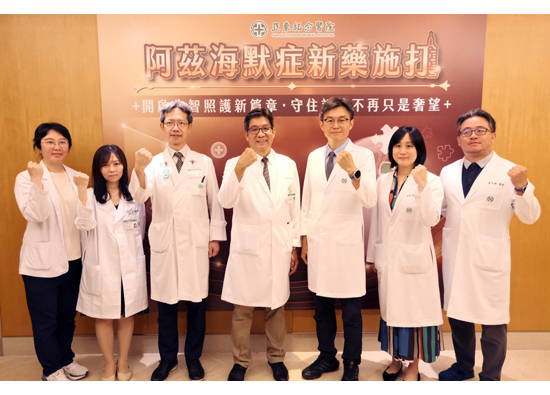
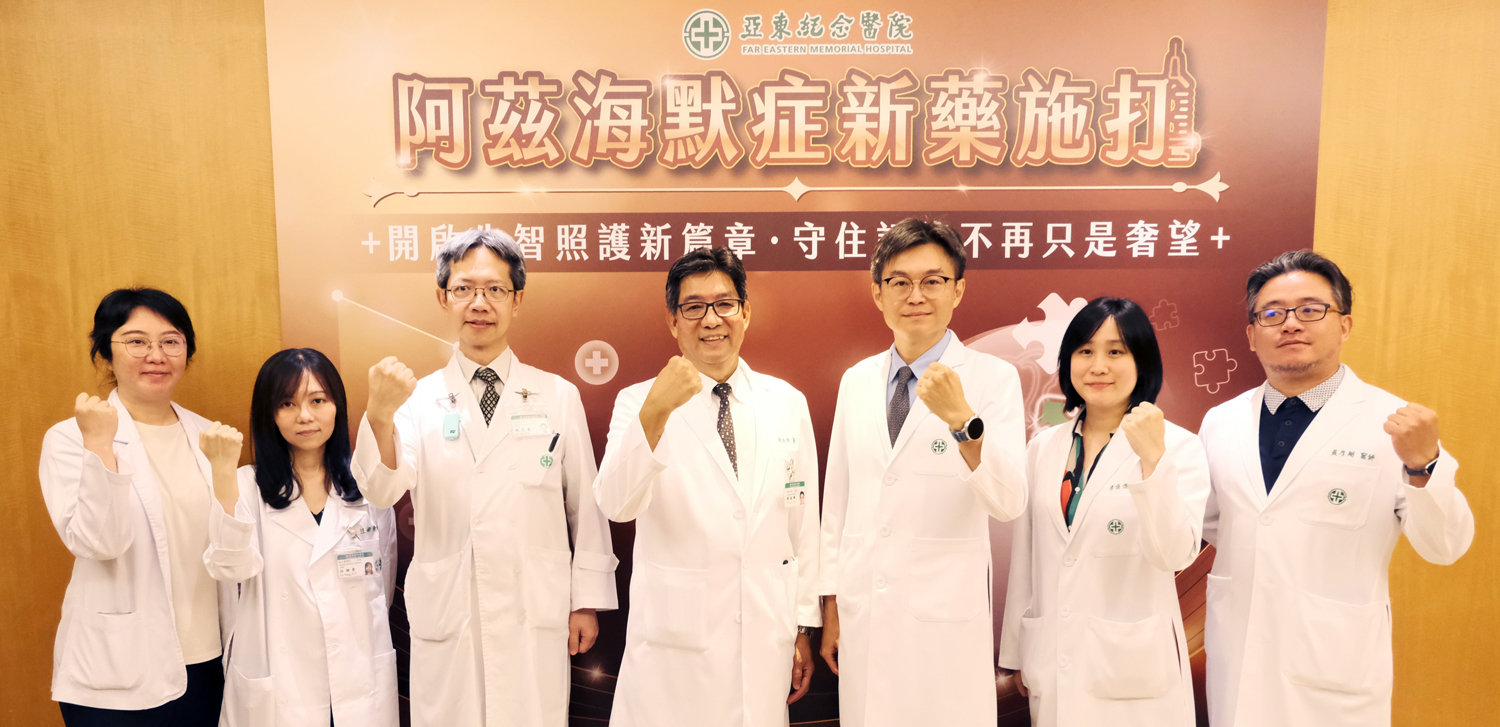 The number of people with dementia in Taiwan has exceeded 350000, with 70% of them suffering from Alzheimer's disease. How to delay degeneration and maintain quality of life has become an important issue. The Ministry of Health and Welfare has approved two innovative injections for early-stage Alzheimer's disease, "Leqembi" and "Kisunla". After a complete examination and evaluation, Far Eastern Memorial Hospital's professional team led a team of medical centers across Taiwan to administer "Kisunla" to an 83 year old female case on June 23, opening a new chapter in the treatment of Alzheimer's disease in Taiwan.
Dr. Chiu, Dean Kuanming, stated that the implementation of the new drug is not only an important milestone for Far Eastern Memorial Hospital's medical team, but also represents a crucial step for Taiwan in the field of precision medicine for dementia. We look forward to using new drugs combined with imaging diagnosis, genetic testing, and interdisciplinary integrated care to provide patients with earlier and more dignified treatment options.
Seize the golden treatment opportunity, intervene with new drugs in advance to delay degeneration
Dr. Zhen Ruixing, Chief of the Dementia Center of the Department of Neurology, explained that although the patient is elderly, their daily living functions are still good. They can take public transportation alone, handle household chores, and even assist in taking care of their spouse with dementia at home. She took the initiative to seek medical examination after discovering that she had symptoms such as forgetfulness and repeated questioning, as well as a case of dementia at home. After preliminary evaluation, the patient's cognitive impairment test (CASI) score was 92 out of 100, and the Mini Mental State Examination (MMSE) score was 29 out of 30, indicating mild cognitive impairment. Subsequently, through magnetic resonance imaging, positron emission tomography (PET), and genetic screening, it was confirmed that amyloid like protein had been deposited in the brain and met the indications for the new drug. Section Chief Zhen Ruixing pointed out that this is the golden time for drug intervention. The purpose of new drugs is not to reverse memory, but to delay degeneration, prolong the time for patients to maintain their daily living abilities, and maintain a clear and dignified quality of life.
Delaying not only diseases, but also familiar daily routines in memory
The family said that although the treatment cost of the new therapy is not low, considering that the mother can still live independently, she arranges her own schedule every day, completes household chores, and takes care of her father. This kind of life is very important to her, so she decided to actively try the new drug. As long as the mother's current state can be maintained for a longer time, it is worth it for the whole family. This rational and gentle expectation also reflects the helplessness and hope of many caregivers when facing dementia. They do not pray for miracles to happen, but only hope to preserve some familiar daily life and family interactions. As long as elders remember their family names or can have a meal together, it is a moment worth cherishing.
New dawn for Alzheimer's disease, Taiwan introduces new drug capable of clearing amyloid like proteins in the brain
The approved "Happy Bao" and "Xin Zhi Le" are monoclonal antibody drugs that delay neurodegeneration at the source by clearing pathogenic amyloid proteins in the brain. This is the first time in 20 years that Taiwan has introduced new drugs for the treatment of Alzheimer's disease.
Leqembi: jointly developed by Japan's Weicai and the United States' Baijian, administered once every two weeks and can be extended to once a month after one and a half years. Early patients with low starch accumulation can slow down to 51%, delaying the onset of moderate to severe disease by about 3 years.
Kisunla: Developed by Eli Lilly in the United States, administered one injection per month, research shows that about 66% of patients can completely eliminate amyloid protein after one year; The rest will take about 1.5 years. Some patients may temporarily suspend treatment after clearance, but regular follow-up is still necessary. Helps reduce the risk of progressing to moderate dementia by 50%, or delay the course of the disease by about 4-5 years.
Section Chief Zhen Ruixing emphasized that both drugs are administered intravenously and must be administered in a hospital. Prior to treatment, assessments such as amyloid positron emission tomography (PET), brain imaging (MRI), and APOE gene testing must be completed. Clinical data shows that a very small number of patients may experience cerebral edema or punctate bleeding, which requires imaging monitoring to ensure the safety of the treatment course.
Not suitable for everyone, new drugs need to undergo a complete medical evaluation before they can be administered
Some patients who have a history of stroke or epileptic seizures within the past year, carry the APOE (ε 4/ε 4) gene, or are currently taking anticoagulants are considered high-risk groups. Currently, it is estimated that there are about 130000 patients in Taiwan who meet the medication requirements for "early Alzheimer's disease+amyloid positive". However, due to the treatment cost of approximately 1-1.5 million NTD per year, the actual number of patients who can be treated is still limited.
At present, more than ten early dementia patients at Far Eastern Memorial Hospital have completed complete screening, of which six or seven meet the criteria and are discussing with physicians whether to initiate treatment. Section Chief Zhen Ruixing added that new drugs are not a panacea, but a step in medical progress, and need to be accompanied by life care, psychological support, and long-term tracking in order to truly make sense.
Taking a critical step forward, ushering in a new milestone for dementia in Taiwan
With the diversification of drug choices, the popularization of diagnostic tools, and the increasing awareness of dementia care in society, Taiwan will be more capable of coexisting with dementia, allowing patients and their families to experience a more stable and high-quality life together. Section Chief Zhen Ruixing stated that dementia care is not only about innovative breakthroughs in the medical field, but also requires sound policy systems, community resources, and a friendly environment to support and prevent the silent loss of memory. This is the direction that Far Eastern Memorial Hospital insists on striving for. Dr. Chiu, Dean Kuanming, emphasized that dementia is not just a medical issue, but also a significant challenge for families and society. Far Eastern Memorial Hospital will continue to fulfill its medical center responsibility by investing in the introduction and clinical application of new therapies through an integrated medical model. At the same time, it will strengthen education and support for patients and their families, promote comprehensive services for dementia diagnosis, treatment, care, and family support, and work together with society to create a dementia friendly medical and living environment.
#