
06.2026 Office Talk
Embrace the influence of AI generated search and reconstruction enterprises
Group Integrated Efficiency and Retail Planning Headquarters / Digital Marketing and Public Relations Group

 For a long time, search engines (such as Google Search) have played a crucial interface between businesses and their market/target audience, whether it's customer development, brand evaluation, or product research, all begin with search. However, generative AI shifts search from "link oriented" to "answer oriented", allowing users to make judgments before entering the website. This article analyzes the key impact of this transformation on business operations and proposes strategic directions in the era of Generative Search (GEO) to help group enterprises plan ahead and seize future leadership.
Standing at the turning point of the search ecosystem in 2026, enterprises and brands are facing irreversible changes: as generative AI can instantly integrate and respond to most information needs, the traditional digital model centered on "click to guide" is rapidly loosening.
According to a study by The Digital Bloom in 2025, nearly 60% of search behavior has entered a "zero click" state. In other words, users no longer need to enter the website to obtain complete information from search pages or AI answers. This is not only a shift in traffic sources, but also a reconstruction of how influence is distributed.
Structural Change in the Zero Click Era
In the past, as long as a brand achieved search rankings, it could gain traffic and conversion, making SEO (Search Engine Optimization) and SEM (Search Engine Marketing Keyword Advertising) the core battlefields of digital marketing.
However, the emergence of generative AI has transformed search results from "linked lists" to "answers themselves", allowing information retrieval to be filtered through multiple steps and completed in one go. This means that website traffic is no longer the only entry point that affects user decisions, but brand influence has not disappeared, but is pushed forward to the process of AI generating answers.
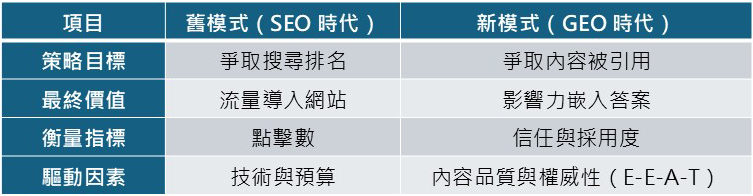
Generative AI does not generate content out of thin air and still relies on existing data sources for integration and citation. Research shows that users attracted through AI often have clearer needs and higher trust foundations, and their conversion efficiency is actually better than traditional search traffic. Therefore, in the era of AI, the core of competition is rapidly shifting from "striving to be clicked" to "striving to be referenced by AI". SEO has gradually extended to GEO (Generative Engine Optimization), and companies should redefine key brand marketing KPIs: shifting from traffic growth to influence penetration and trust building.
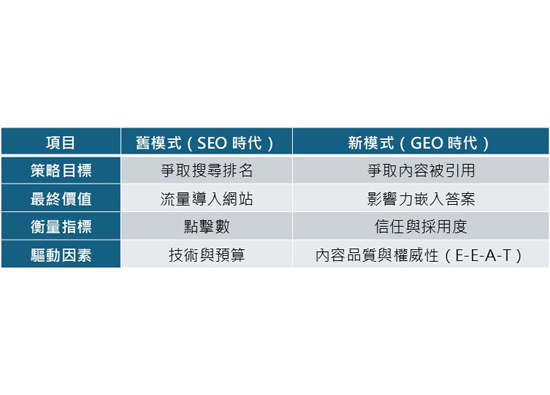
Table 1: SEO vs GEO: The Shift of Competitive Logic
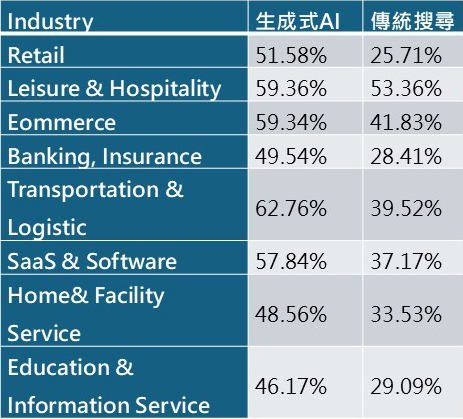 Table 2: Click through conversion rates for various industries (Source: Web Fx, January 2024 to December 2025)
Practical Strategy: Building a Content System Trusted by AI
In the era of zero clicks, the value of content is no longer determined by exposure, but by being trusted and adopted. The following key strategies are gradually becoming the core of the new generation of content competition:
A. Enhanced content of E-E-A-T:
Experience: Content creators need to "actually" use the product, "visit the location" in person, or share their personal "real" experience, providing first-hand use or observation, such as the unboxing experience of the editor's product.
Expertise: Content produced by individuals with professional backgrounds, such as lawyers explaining law, doctors explaining health, and shopping center practitioners discussing mall management.
Authoritarianism: Refers to being cited or endorsed by other credible sources, including well-known websites, certifications, or industry awards.
Trustworthiness: Whether the information provided by a website is accurate, honest, and trustworthy, such as Reuters' credibility being higher than that of unknown tabloids.
In the long run, these factors will accumulate into the brand's' trust weight 'in the AI system.
B. Establish structured knowledge-based content: Compared to one-way product introductions, structured and directly answerable content is closer to the user's thinking context and is easier to be captured and reorganized by AI, such as FAQs, purchase guides, comparative analysis, etc.
C. Structured Data Markup (Schema): Content should not only be visually appealing, but also easy for AI to read. Clear title hierarchy (such as H1, H2), unified product and information formats, and structured data can significantly increase the chances of being referenced.
D. The content strategy of "evergreen" and "extensibility": Instead of introducing a single product, it is better to expand to the usage context and related knowledge, such as selling coffee. In addition to introducing bean seeds, it can also be extended to brewing techniques, flavor differences, and equipment selection. When the content covers diverse and detailed questioning scenarios for users, there is an opportunity for AI to repeatedly cite and continuously expose it in different questions.
E. Inverted pyramid style writing: Place the most crucial answer at the beginning and directly respond to the question in the preceding text, followed by additional reasons, background, and extended information. This not only conforms to reading habits, but also helps AI quickly grasp key points and improve the accuracy of retrieval.
From traffic management to trust management
Looking globally, leading companies have actively responded to the changes brought about by generative search. For example, Walmart maintains visibility in voice search and generative responses by strengthening its product data structure and AI integration capabilities; Target deepens its content management by utilizing contextual and long-term knowledge to enhance the degree to which its brand is referenced and trusted by AI.
This trend has also rapidly expanded to non retail sectors, with financial, tourism, and technology companies collaborating with generative AI platforms to connect their knowledge bases with models, allowing brands to directly participate in answer generation. This shows that the ability to be referenced by AI is becoming a new infrastructure for enterprise competition. Enterprises should pay early attention and systematically construct content and knowledge assets in order to occupy a place in future search and decision-making systems. In this wave of transformation, proactive planners will participate in the formulation of rules; Passive responders can only respond to changes. Mastering trends and taking action in advance can leverage AI to drive the group towards long-term and sustainable competitive advantages.
#