
01.2026 Life Guide
Three stage savings technique: starting from scratch to save the first bucket of gold
Far Eastern International Bank / Chen Yifan


 The salary has just been received, but it disappeared like it was blown away by the wind in a few days; Every month at the end of the month, I make up my mind to save money well, and even after a few months, my account still has very little left... Do you feel familiar with the above situation? The key to transitioning from 'wanting to save money' to 'truly having savings' is not how much one earns, but finding a way to persistently and disciplined accumulate assets. This issue of 'Finance Column' helps you take the first step towards saving money!
 The Importance of the First Bucket of Gold
The first bucket of gold may not necessarily be a lot, but its role is like "seed capital" in life, with three major meanings:
Safety net in emergency situations: not afraid of unexpected events, maintain a steady pace of life.
The starting capital for investment: To make money roll over, one must first have a principal.
The foundation of financial planning includes buying a house, starting a business, and pursuing self-improvement.
Simply put, it's not about saving money after becoming wealthy. It's about saving money before becoming wealthy, and with the first bucket of gold, one begins to have the freedom of choice.
Saving money is actually training the rhythm of life
'Disciplined saving' may feel stressful, but it's not about living an ascetic life, it's about finding a sense of rhythm between life and money. Firstly, it is necessary to master the following three concepts:
1. "Income savings=expenses" is the correct order
Many people, upon receiving their salary, feel that they have worked hard for a month and immediately reward themselves by buying things, ordering food, arranging gatherings, etc. They wait until the end of the month to see if there is any money left, but of course, they cannot save it. It is recommended to deduct necessary living expenses such as rent, utilities, and transportation as soon as you receive your salary, and then force yourself to save a fixed percentage before using the rest for expenses. In other words, "saving first and then spending" is one of the most effective ways to save money.
2. Clear goals are more effective than shouting slogans
Don't just want to save money, set specific goals, such as saving NTD 100000 per year, which means saving approximately NTD 8400 per month. If there is a clear amount, period, and purpose for saving money (such as a travel fund), there will be a direction for action and progress tracking.
3. Automated financial management methods that even lazy people can do
Human nature is always easy to forget and lazy to execute. It is recommended to save energy through automated methods, such as setting up automatic transfers, sub account savings, regular fixed amount savings, etc. After all, relying on the system is more practical than relying on determination.
Three stage savings technique: starting from scratch and gradually saving money
Even if there is not much deposit in the account now, it doesn't matter. The key is to establish a 'sustainable process'. The following is a three-stage savings technique suitable for all beginners.
Stage 1: Clarify the flow of expenses
Don't rush to save money yet, instead use a mobile notepad, simple notes, or even bank statements to record personal expenses and understand your spending behavior. Suggestions can be divided into three categories: (1) Must spend: rent, utilities, and transportation. (2) Controllable: eating out, shopping, and beverages. (3) Impulsive spending: swiping your phone to buy things, offering limited time discounts, etc. You will find that a lot of money is actually 'unconsciously lost'. As long as you drink fewer coffee drinks and order one or two less deliveries every month, you have the opportunity to save thousands of yuan more.
Stage 2: Use a mandatory mechanism to hide the money
When you can generate a stable balance every month, you should enter the stage of strengthening savings discipline. For example, opening a separate account specifically for savings, setting up automatic salary transfer to the savings account, and setting the savings account as the one that is not frequently logged in or viewed, which makes it easier to use and save money.
Stage 3: Let the money grow slowly
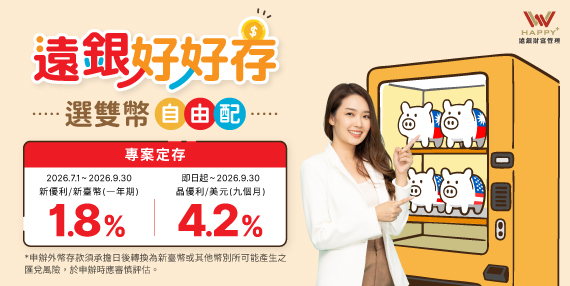
After accumulating tens of thousands of NT dollars, it is recommended to further consider: "Is there a chance for this money to roll out more?" At this point, you can start trying some "low-risk" and "stable" investment methods, including small fixed term investments (such as funds, ETFs, etc.), or choosing savings plans with higher interest rates (such as Far Eastern International Bank's "Livelihood Prosperity" project, which meets the application requirements by the end of 2025 and can receive a discount of up to 1.4% annual interest rate for living savings in Taiwan dollars), so that time and principal can automatically become your helpers.
Don't let the hard-earned money go to waste
The money you try hard to save may even go to zero if you are not careful. Here are a few landmines that you must be careful of:
Emotional spending: When you feel tired, you want to spend money to reward yourself, be careful not to become a moonlight tribe.
Advance future income: Starting to spend before the end of the year is a common trap.
Using savings without emergency reserves: There are always unexpected events in life, so preparations should be made in advance to avoid using long-term savings.
If you have ever failed to save money, it's okay; If you feel like you're not earning much, don't worry. It's never too late to save money. Only by starting can you make a change. Whether it's saving NTD 1000 every month or starting with recording daily expenses, as long as you hold onto it, the first bucket of gold will gradually take shape.
On Podcast Channel S2-E7 of "Ten Joys Without Money in Life", how can young people start financial planning to get rid of refined poverty? 】In the program, the director of Far Eastern International Bank shared his journey from being a migrant worker to accumulating his first bucket of gold step by step, and reminded everyone how to avoid falling into the trap of "exquisite poverty". Welcome to click on the single episode link, scan the QR code, listen to more practical financial stories, and find your own savings rhythm.
Related warning: For details of the Huoliwang project, please contact personnel from each branch or visit the activity section on the official website. Careful evaluation should be conducted before applying, and foreign currency deposits must bear the exchange risk arising from future conversion into New Taiwan Dollars or other currencies. In addition, there are gains and losses in fund investment, and the prospectus should be carefully read before subscription.
*Image source: freepik
#