

02.2026 Office Talk
Using books as a medium to unlock new ways of communication
Asia Cement Corporation (China) / Peng Li

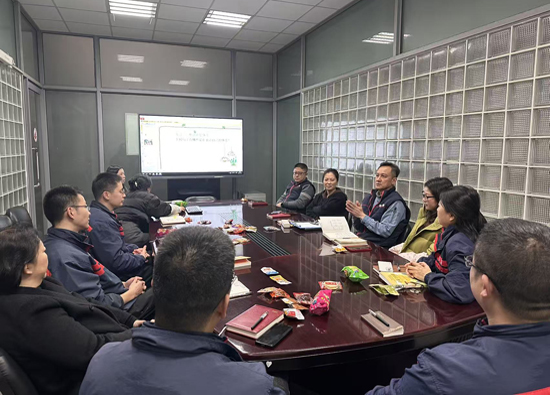
 In the busy and compact work, Asia Cement Corporation (China) Southwest Purchasing Depot injected a unique warmth and Go Prosperous volume into the team - the department's second book club was held as scheduled, and we were fortunate to invite Director Xie Mingcang of the Administration Department, who is currently on a business trip in Sichuan, as well as colleagues from the Southwest HR department to attend.
This joint reading focuses on the classic book "Nonviolent Communication" in the field of communication, aiming to use books as a bridge to enhance team communication skills and empower procurement work.
The book club was initiated by Mr. Zhang Aiming from the Purchasing Depot in Southwest China. As a pioneer in this sharing, he read the entire book in advance, combined with his own understanding and thinking of the concept of "nonviolent communication", carefully created a logically clear and detailed PPT, avoiding obscure theoretical stacking, and using popular language to break down the core framework of the book. Starting from the four elements of "observation, feeling, need, and request", he clearly sorted out the writing purpose of "resolving communication conflicts and establishing sincere connections" in this book. He also expressed it humorously and interspersed small stories of communication in daily life, allowing colleagues who have not yet read this book to quickly establish a cognitive framework for "nonviolent communication", and instantly ignited everyone's interest in this book, laying a relaxed and focused atmosphere for the book club.
As the sharing deepens, the book club enters an interactive phase, where each participating colleague selects paragraphs from the book that touch them one by one, reads them aloud on site, and shares their insights with practical cases from work and life. This stage breaks the one-way output mode, making everyone a sharer and listener. Some people reflect on their language habits when communicating with suppliers from the perspective of "distinguishing observation and evaluation" in the book; Some people are discussing how to maintain a rational attitude in procurement negotiations around "expressing feelings rather than blaming"; Some people combine "clear requests rather than commands" to sort out optimization directions for cross departmental collaboration.
Among them, Ms. Hu Liu's sharing from the Purchasing Depot in Southwest China is particularly resonant. She mentioned that recently, due to the supplier's lack of cooperation in the raw material settlement process, work has come to a standstill, and she has also experienced anxiety, almost following her usual habit of communicating with emotions. Fortunately, the concept of "paying attention to the other party's needs before expressing her own needs" from "Nonviolent Communication" suddenly came to mind. She immediately adjusted her mentality, listened to the supplier's questions and concerns about the settlement process, patiently explained the company's regulations, and worked together to find a solution that met the needs of both parties. In the end, not only did they successfully complete the settlement, but they also learned that the other party's emotions were affected by recent family matters, which further strengthened their relationship with the supplier. She sighed and said, 'Without the inspiration of this book, it was very likely that we would have fallen into an argument at that time, which would have affected the progress of the work and disrupted the atmosphere of cooperation.'. This real-life case made the colleagues present more intuitively feel the value of 'nonviolent communication' in practical work. Several colleagues on site also shared their experiences of applying the methods in the book to team collaboration, cross departmental communication, and even family communication. Each case is full of details and warmth, allowing everyone to see their own hearts from others' stories, and their understanding of "nonviolent communication" has been put into practice from a theoretical level.
For procurement work, communication is a core skill that requires efficient and sincere communication as support, whether it is negotiation games with suppliers, process integration with the finance department, or coordination of production department needs. This book club on "Nonviolent Communication" not only allowed colleagues at the Purchasing Depot in the southwest region of Asia Cement Corporation (China) to systematically learn communication methods, but also achieved experience sharing and ideological collision through interactive sharing. Everyone expressed that in the future, they will translate the ideas in the book into practical actions in work and life, communicate in a more peaceful and rational way, and inject new vitality into strengthening team cohesion and promoting efficient work implementation.
#