

03.2026 Life Guide
The role of positron emission tomography in cancer screening
Dr. Wang Shanying, Department of Nuclear Medicine, Far Eastern Memorial Hospital /


 According to statistics from the Ministry of Health and Welfare, the total number of deaths in Taiwan in 2024 was 201000. Among them, "cancer" remained the top ten cause of death for 43 years, accounting for 26.8% of the total number of deaths. In addition, the cancer clock is also turning fast, with an average of one person dying of cancer every 9 minutes and 58 seconds. The number one killer is still lung cancer, followed by liver cancer and colorectal cancer; The fourth to tenth places are female breast cancer, prostate cancer, oral cancer, pancreatic cancer, gastric cancer, esophageal cancer, and ovarian cancer, in order. Cancer has complex pathogenic factors and a long incubation period. Only through effective screening, early detection, and correct diagnosis can we seize the opportunity for treatment. This issue of 'Health Column' introduces positron emission tomography as a reference for future health check ups.
 Various inspection methods have their advantages and limitations, and the security risks of invasive inspections should also be considered. The most important clinical value of positron emission tomography lies in its ability to accurately diagnose cancer staging, including the presence or absence of distant metastasis, evaluation of efficacy and tracking, and it is safe and painless, and can be used for large-scale whole-body examinations. Before a health check-up, it is recommended to consider the individual's health condition and needs. If there is a family history of cancer or if the individual is over 40 years old, in addition to traditional health check-up procedures, a full body positron emission tomography scan can also be used as a tool for precision medicine.
What is positron scanning
Positron Emission Tomography (PET/CT) is a composite scanner that combines Positron Emission Tomography (PET) and Computed Tomography (CT). It is a significant medical invention in recent years. In addition to using deoxyglucose to detect the positive function imaging of high metabolic tumor lesions in the body, computerized tomography is also used to accurately locate the structure, which can greatly improve the accuracy of diagnosis.
Fluorine-18 deoxyglucose positron scan
Different biological tracers can be used to track different molecular biological information of cancer. For example, the tracer "18F fluorodeoxyglucose (FDG)" isotope drug has a structural formula similar to glucose in the human body. After entering the body, it is absorbed by body tissues and distributed throughout the body. Generally speaking, cancer cells grow rapidly and have a metabolic rate that is 2-10 times higher than that of normal tissue cells. Therefore, systemic scanning can be used to locate these high glucose metabolism cancer cells.
PSMA positron emission tomography monitoring of prostate cancer lesions
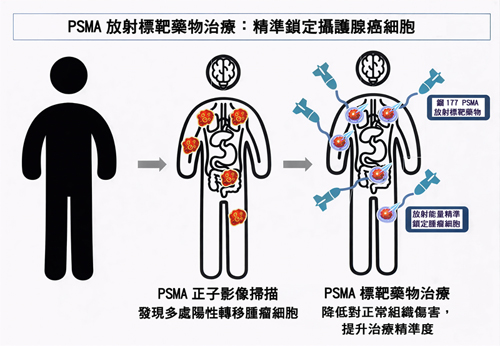
PSMA PET is a molecular imaging examination used to accurately identify the location of prostate cancer and its metastasis. It utilizes targeted nuclear medicine drugs that specifically bind to prostate cancer cell expression antigens (such as POSLUMA, F-18 flotufolastat) to detect tumor location through scanning. It is suitable for patients suspected of metastasis after diagnosis, or high-risk patients as a reference for subsequent treatment decisions, as well as those with increased cancer index PSA after treatment, suspected recurrence but difficult to detect the cause through general examinations. Compared to traditional CT, MRI, or bone scans, PSMA PET can detect recurrent or metastatic lesions with only a slight increase or even below 0.5 ng/mL in PSA, which is crucial for early detection and subsequent treatment assessment. In addition, it is also a key examination for evaluating the suitability of Lu-177 PSMA radiotargeted therapy to confirm whether the tumor has sufficient PSMA expression. However, PSMA positive screening and treatment have not yet been included in health insurance coverage.
Safety of PET/CT positron emission tomography
Unlike contrast agents, fluoro-18 deoxyglucose has a structure similar to glucose in the human body and rarely causes allergic reactions. There have been no reports of significant side effects in patients both domestically and internationally. Although there are no specific contraindications, due to the trace radiation of isotope drugs, it is not advisable to undergo this examination for those who may be pregnant or are already pregnant.
The positron emission tomography scanner set up at Far Eastern Memorial Hospital can reduce the dose of radioactive isotopes used in the examination to half of the original, greatly reducing the exposure to the tested radiation. The half-life of the radioactive isotopes used during the examination is about two hours, and most of them will be excreted in urine. After 20 hours, there is almost no residual radiation on the patient's body (which is already the background value), and no special radiation protection is needed. The radiation dose received during a full body positron emission tomography scan is approximately equal to the dose received during an abdominal computed tomography scan.
It is worth mentioning that in order to improve the sensitivity of the examination, fasting for 6 hours is required before performing the deoxyglucose positron test. After injecting deoxyglucose, the subject will rest in the low light injection room for 40 minutes, wait for the drug to be absorbed, and then start the imaging procedure. During the imaging period, it may be necessary to ask the subject to drink water or to rescan at a delayed time to obtain clear images.
Indications of Fluorine-18 Deoxyglucose PET/CT positron emission tomography and its application in health examinations
Every medical examination has its advantages and disadvantages, and deoxyglucose positron emission tomography also has some limitations. When the tumor volume is too small, the sensitivity of positron emission tomography is relatively low. In addition, the metabolic rate of some tumors themselves is not significantly abnormal compared to surrounding tissues. For example, the application of hepatocellular carcinoma, urinary system cancer (kidney cancer, bladder cancer cancer and prostate cancer) and primary brain tumor is not ideal. It is recommended to use other examinations to enhance the diagnostic rate.
Conclusion
According to literature reports, about 1-2% of asymptomatic health check subjects can detect malignant tumors early through deoxyglucose positron emission tomography. Intentionally choosing this method as a comprehensive cancer screening option, Far Eastern Memorial Hospital's Health Management Center and Nuclear Medicine Department have rich experience in providing detailed consultation services and supporting examinations and evaluations to more comprehensively protect the health of you and your family.
Dr. Wang Shanying's expertise includes nuclear medicine imaging, positron emission tomography, and molecular imaging. For detailed introduction, please refer to: https://www.femh.org.tw/section/sectionDetail2.aspx?CID=0350&&DoctorID=89198
#